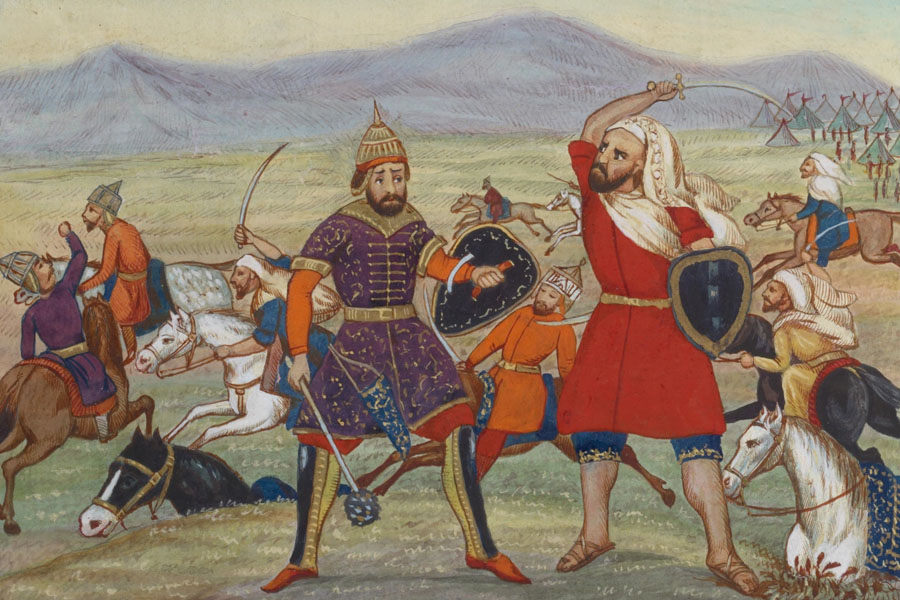
A Noble Birth in a Fracturing Empire
Rostam Farrokhzad emerged from the House of Ispahbudhan, one of the Sasanian realm’s most eminent noble lineages. His birth likely fell between the late 590s and the early 610s CE. That period was already steeped in dynastic tension and military anxiety. He grew up amid aristocratic privilege, but also amid imperial fatigue. The empire still glimmered, yet its foundations had begun to fissure.
The Ispahbudhan family traced prestige through Parthian and Kayanid claims. That ancestry gave the house ceremonial weight and political confidence. Rostam inherited more than wealth. He inherited obligation, hazard, and a sharpened sense of honor. In a court culture built on lineage, that inheritance mattered enormously.
He became spahbed of Adurbadagan, the northwestern military district. That office placed him near strategic frontiers and volatile provinces. It also gave him command over troops, revenues, and regional security. His authority later broadened beyond one quarter of the empire. By the final civil wars, he had become a central pillar of imperial survival.
The Family Bond That Shaped His Career
Rostam’s family was not decorative background. It was the engine of his rise. The house of Ispahbudhan stood among the seven great noble families. These families intermarried with royalty and guarded immense estates. They also managed armies that could alter succession itself.
| Family Member | Relation | Role and Significance |
|---|---|---|
| Farrukh Hormizd | Father | Powerful prince, spahbed of Adurbadagan, rebel leader in 627 to 628 CE, murdered around 630 to 631 CE |
| Farrukhzad | Younger brother | Military and political figure, later spahbed, defended Ctesiphon, linked to Tabaristan resistance |
Farrukh Hormizd shaped the family’s zenith. He was a cousin of Khosrow II and a formidable player in royal politics. He joined rebellion during the imperial crisis of 627 to 628 CE. That rebellion helped topple Khosrow II. His murder by Queen Azarmidokht, around 630 or 631 CE, became a political wound. It also became a personal summons for Rostam.
Rostam’s response was swift and severe. He entered Ctesiphon, seized control, and punished the queen. He then restored Queen Boran in June 631 CE. That act was not merely vengeance. It was a restoration of order through force. It also demonstrated how nobles could still make and unmake kings.
Farrukhzad, the younger brother, carried the family’s burden afterward. He served in the capital and continued military resistance after Rostam’s death. Later traditions connect him with the Bavand dynasty in Tabaristan. That northern line preserved Sasanian memory for generations. Family, for the Farrokhzads, was both inheritance and battlefield.
Authority, Administration, and War
Rostam’s career was not limited to combat. He administered lands, secured taxes, and managed provincial order. Such duties mattered during the civil wars of 628 to 632 CE. Royal authority was brittle, and governors often behaved like regional sovereigns. Rostam navigated that disorder with calculated severity.
He supported the coronation of Yazdegerd III in 632 CE. That young king represented continuity when continuity was scarce. Rostam became one of the regime’s principal protectors. He fortified positions, coordinated defenses, and organized major military resources. His command included heavy cavalry, elite retainers, and war elephants. Such forces required immense coordination and rich estates.
His wealth came from family domains, tax privileges, and inherited patronage. The Sasanian economy was not a simple treasury system. Power rested on noble lands and local obligations. Rostam’s campaigns therefore drew upon a private aristocratic machine. He was not merely a general. He was a magnate of war.
The Road to Al Qadisiyyah
By 634 CE, Arab advances had grown serious and relentless. Rostam moved to contain them with fortifications and strategic patience. He camped near al Qadisiyyah for months. Negotiation, maneuver, and stalemate marked much of that period. He understood that delay could still serve empire.
The Persian host at al Qadisiyyah was immense. Estimates vary, but the force was clearly large and highly structured. It included cavalry, infantry, and specialized units. The army also carried the weight of dynastic desperation. Rostam knew that a single defeat could unravel decades of resistance. Yet he still chose to stand.
His final battle occurred in November 636 CE, or possibly around May 637 CE. The chronology remains debated, but the consequences do not. Rostam died in combat, amid confusion, dust, and catastrophic reversal. Some traditions describe a storm or chaotic injury. Others preserve the memory of a decisive strike. Whatever the exact sequence, his death echoed across the empire.
The battle later became known as the Day of Rostam. That name alone reveals his stature. He was not simply one commander among many. He embodied the empire’s last concentrated hope. After his fall, the Sasanian center lost one of its strongest defenders.
A Compact Timeline of Ascending Crisis
| Date | Event |
|---|---|
| Late 590s to early 610s CE | Birth into the Ispahbudhan house |
| 627 to 628 CE | Joins rebellion against Khosrow II |
| 630 to 631 CE | Avenges Farrukh Hormizd, captures Ctesiphon, restores Boran |
| 632 CE | Supports Yazdegerd III’s coronation |
| 634 to 636 CE | Prepares defenses near al Qadisiyyah |
| 636 CE or 637 CE | Dies at al Qadisiyyah |
| 636 to 651 CE | Farrukhzad continues resistance in the north |
This sequence shows compressed upheaval. In less than four decades, power shifted repeatedly. Rostam moved from noble heir to kingmaker, then to final defender. His life unfolded inside one of the empire’s steepest declines. Few careers have been so tightly bound to collapse.
Rostam in Memory and Literature
Rostam Farrokhzad also survived in literary memory. The Shahnameh presents him as wise, grave, and foresighted. It preserves a famous farewell to his brother. That letter is charged with sorrow and duty. It frames resistance as moral endurance, not mere military pride.
Such portrayals magnify his historical outline. They also expose the emotional cost of imperial decline. Rostam appears as a man who understood inevitable loss. He still chose loyalty over retreat. That choice gave his name lasting resonance.
His image endures because it combines discipline and tragedy. He was neither a carefree hero nor a simple martyr. He was a statesman of declining fortunes. He maintained order while order was dissolving. That tension gives his story unusual force.
Key Takeaways
Rostam Farrokhzad was a leading Sasanian commander from the House of Ispahbudhan. He rose through noble inheritance, military command, and political crisis. His father, Farrukh Hormizd, shaped his political path through rebellion and murder. His brother, Farrukhzad, continued the family’s resistance after 636 CE. Rostam restored Queen Boran, supported Yazdegerd III, and defended the empire at al Qadisiyyah. His death in 636 CE or 637 CE symbolized the weakening of central Sasanian power. His life remains a stark emblem of discipline, loyalty, and doomed grandeur.